Your contractor has disappeared mid-build: what should you do?
Your contractor no longer answers, the site has stopped and you have already paid instalments. Here are the steps to take to protect your rights and get the work going again.
Published on 2 April 2026 · Updated on 9 October 2026 · Reviewed against the official texts on 9 October 2026 · By Multi Service de Marrakech Junior
1. Clearly establishing the breach of contract
Before acting, document the situation: the last written contact (text message, WhatsApp, email), the last payment made, the last day the contractor was on site. This timeline will be the basis for every step you take.
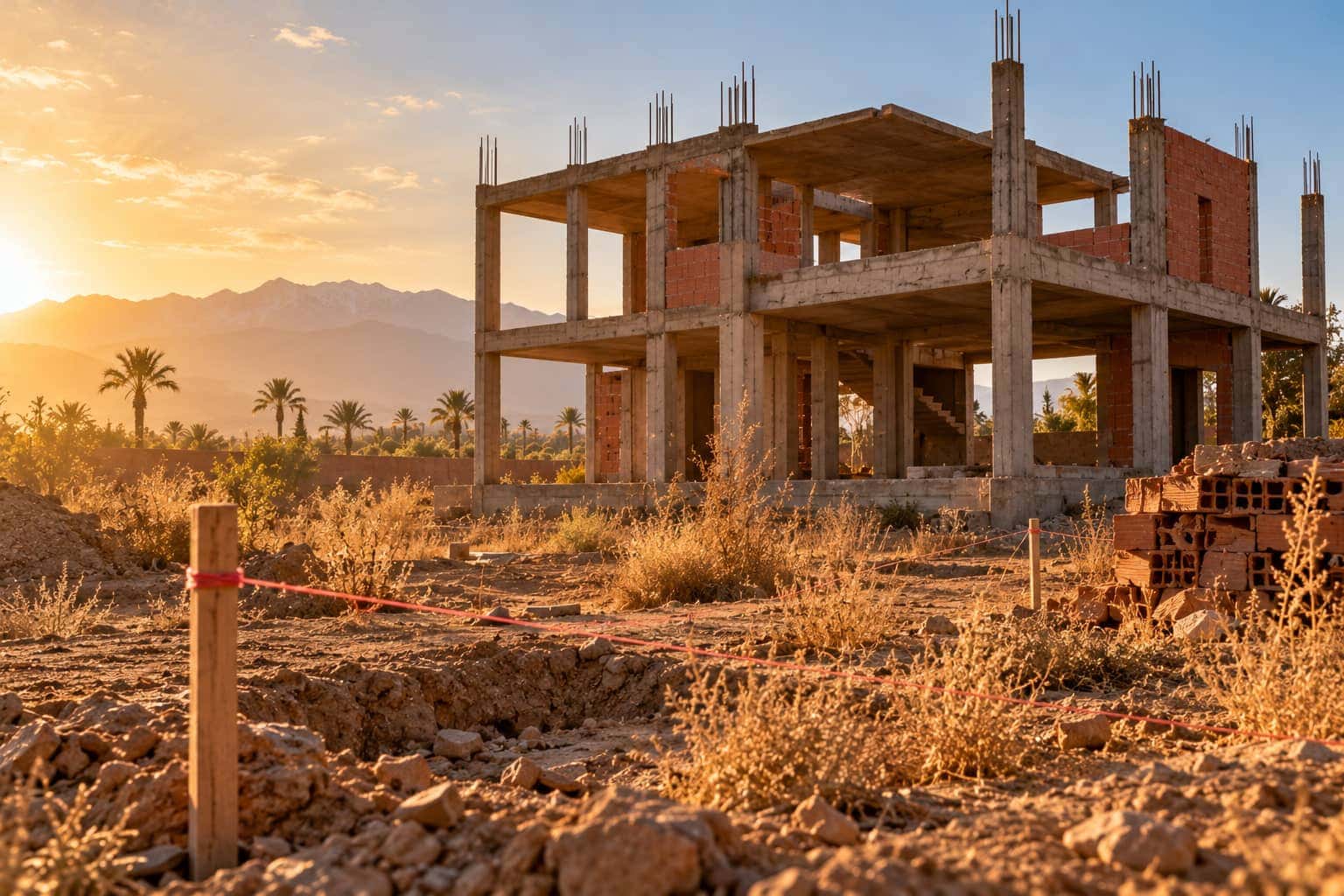
A prolonged, unjustified stoppage of the site, beyond two weeks for example, is a failure to perform the contract, even if the contract has no specific clause on the matter: the Code of Obligations and Contracts then allows you to demand performance or termination of the contract, with damages.
2. Sending a formal notice by registered letter
The formal notice (mise en demeure) is the first formal legal step. It must be sent by registered letter with acknowledgement of receipt to the address given in the contract. It sets a precise deadline for work to resume — usually 8 to 15 days — and tells the contractor what will follow if there is no response.
Keep the acknowledgement of receipt: it proves that the contractor was informed. Without it, a court may consider that the contractor was never formally put in default.
3. Having a bailiff draw up an official report
A bailiff (huissier de justice, a profession reorganised by Law 46-21 of 2025) can draw up an official report (procès-verbal) on the state of the site: work completed, materials on site, condition of the structure. This document has evidential value in court and will be used to assess the sums owed.
The report should be made as early as possible, before materials on the abandoned site can deteriorate or be stolen.
4. The legal remedies available
For a private individual, the court of first instance generally has jurisdiction; the commercial court has jurisdiction for disputes between traders, or where the contract expressly provides for it, for claims above 20,000 MAD (Law 53-95, articles 5 and 6). The claim seeks termination of the contract, repayment of sums wrongly received, and damages.
In an emergency, for example to have the state of the site recorded or to order an expert assessment, the judge for urgent applications (juge des référés) can rule quickly. For the merits of the dispute, expect a longer timeframe and the assistance of a lawyer.
5. Resuming the build with another contractor
Before handing the work to a new contractor, have an independent assessment carried out: a technician or a structural engineering consultancy (bureau d'études) assesses the condition of the structural work, identifies any non-compliance and prices the cost of taking it over. This document protects your new contract.
Include in the new contract full documentation of the work already done, to avoid any ambiguity about responsibilities if a problem arises later.
In summary
The best protection remains a structured contract with payment milestones tied to actual progress, and regular, formal monitoring. Multi Service de Marrakech Junior builds with a shared schedule and progress reports at every key stage.
Sources and reference texts
- Code of Obligations and Contracts (DOC), contractual liability
- Law 46-21 on the organisation of the profession of bailiff (huissier de justice) (2025)
- Law 53-95 establishing commercial courts (articles 5 and 6)
Cite this guide
Using this guide on your website, on a forum, for an association or in a document? Please cite the source with a link to the original page.
“Your contractor has disappeared mid-build: what should you do?”, Multi Service de Marrakech Junior, updated 9 October 2026. https://mmj.ma/en/blog/entrepreneur-disparu-chantier
This article is provided for general information and does not replace advice from a lawyer, a notary or an architect. Legislation changes: check the version in force for your situation.