Building permits in Morocco: the mistakes that cost private owners dearly
Building without a permit or exceeding the authorised limits exposes you to heavy penalties, some of them irreversible. Here are the most common mistakes and how to avoid them.
Published on 15 April 2026 · Updated on 9 October 2026 · Reviewed against the official texts on 9 October 2026 · By Multi Service de Marrakech Junior
1. Building without a permit: the risk of demolition
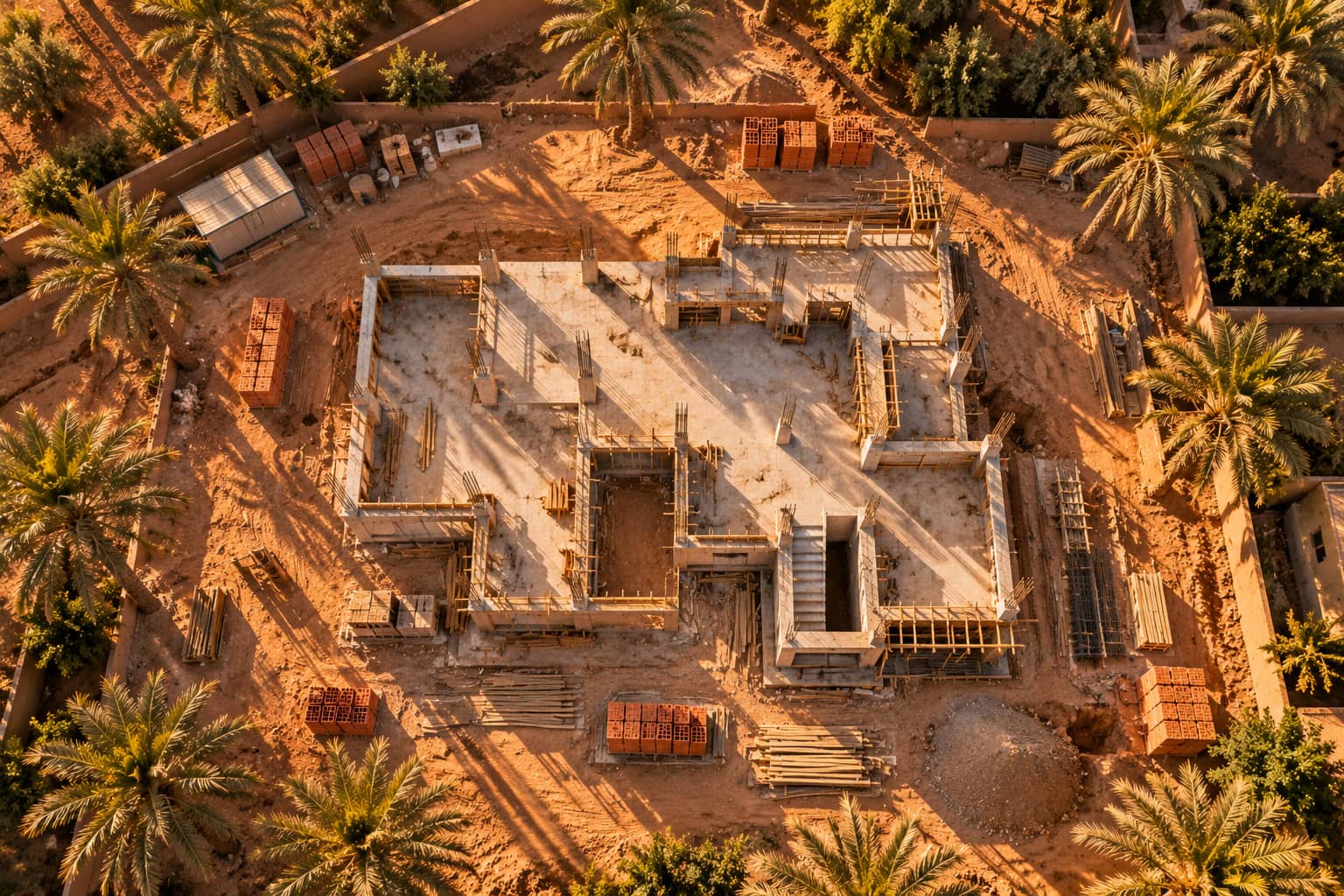
Since Law 66-12, building without a permit is punishable by a fine of 10,000 to 100,000 MAD, doubled for a repeat offence, with possible imprisonment of one to three months (Law 12-90, article 71). The planning inspector orders work to stop immediately, the local authority can have the building demolished on its own authority at the offender's expense, and the court orders demolition or bringing the building into compliance (articles 67, 68 and 80-1). The client (owner), the contractor, the architect and the engineer are treated as co-offenders if they did not report the offence within 48 hours (article 78).
A building put up without a permit cannot obtain a definitive land title (titre foncier). It becomes an obstacle to any future sale, inheritance or bank financing.
2. Going beyond the limits of the permit
Building an extra floor or encroaching on the setbacks — even by a few centimetres — is an offence: a fine of 10,000 to 50,000 MAD for exceeding the permit, and 50,000 to 100,000 MAD with possible imprisonment for an added floor (article 72). The inspector orders the site to stop immediately, and demolition of the non-compliant parts may be imposed.
Many owners discover the problem at handover, when it is too late and too expensive to correct. Checks must be made while the work is in progress, not at the end.
3. The permit expiring while work is under way
A building permit is not granted for ever: it lapses if the foundation work shown on the plans has not begun within one year of its issue, or of the expiry of the deadline the commune (municipality) had to respond (Law 12-90, article 49). Before restarting a site that has been stopped for a long time, check with the architect that the permit and the applicable planning rules have not changed.
If the permit has lapsed, a new application is required. It is assessed under the rules in force when it is filed, which may be less favourable than the original ones.
4. Neglecting the completion declaration and the occupancy permit
At the end of the works, the owner must declare their completion to obtain the occupancy permit (permis d'habiter), or the certificate of conformity for a building not intended for housing (Law 12-90, article 55). It is issued after an inspection of the completed works (récolement); where the works were supervised by an architect, the architect's certificate of conformity may be enough. If the municipality has not replied within a month, the owner can refer the matter to the local authority. This step is often neglected, yet in practice water and electricity utilities require it for the permanent connection, and the land title cannot be updated without it.
Living in the house without an occupancy permit is also an offence: a fine of 2,000 to 10,000 MAD for an owner who lives in it, and 10,000 to 100,000 MAD if the owner rents it out or sells it (article 75).
In summary
The administrative side of a building project matters as much as the technical side. Multi Service de Marrakech Junior helps its clients read planning documents and follow the regulatory steps, from filing the permit application to the official handover of the works.
Sources and reference texts
- Law 12-90 on urban planning (Dahir 1-92-31 of 17 June 1992), articles 40 to 58, as amended by Law 66-12
- Law 66-12 on planning and building offences (Dahir 1-16-124 of 25 August 2016, Official Bulletin No. 6501 of 19 September 2016)
- The Rokhas platform (planning permits)
Cite this guide
Using this guide on your website, on a forum, for an association or in a document? Please cite the source with a link to the original page.
“Building permits in Morocco: the mistakes that cost private owners dearly”, Multi Service de Marrakech Junior, updated 9 October 2026. https://mmj.ma/en/blog/permis-construire-maroc-erreurs
This article is provided for general information and does not replace advice from a lawyer, a notary or an architect. Legislation changes: check the version in force for your situation.