How to read a construction quote line by line: comparing offers and deciding
A construction quote is not a price, it is a description. Here is how to read it line by line, spot what is missing, compare two offers on the same scope and turn the quote into a solid contract.
Published on 9 October 2026 · Reviewed against the official texts on 9 October 2026 · By Multi Service de Marrakech Junior
1. The structure of a serious quote
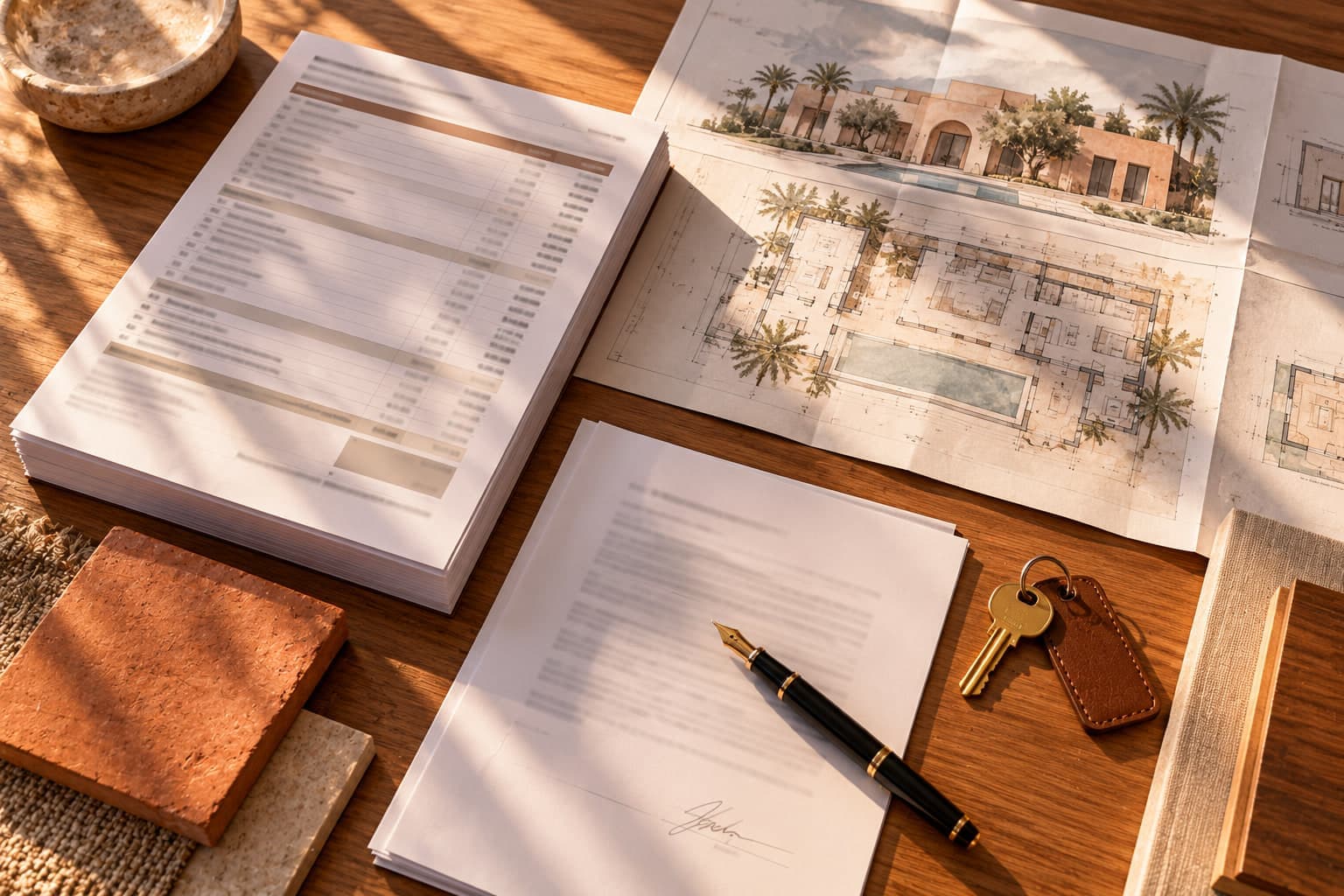
A construction quote reads like a plan: it is divided into trade packages (earthworks, foundations, structure, masonry, waterproofing, electrics, plumbing, doors and windows, floor and wall finishes, painting…), and each package into items. Each item gives five pieces of information: the precise description, the quantity, the unit (m², m³, linear metre, unit, lump sum), the unit price and the total.
A quote presented in three lines, “structural work, building services and fit-out, finishing works”, with an overall price is not a quote: it is an estimate. It does not allow you to check, compare or dispute anything.
2. What each item must specify
The description of an item must remove any ambiguity about what will be delivered. A few examples of what to look for:
- Concrete: strength class (for example C25/30), source (ready-mix plant or mixed on site), and type of reinforcement (HA Fe500 high-bond steel).
- Masonry: type of brick or concrete block, thickness, mortar.
- Tiles and zellige: brand or workshop, format, grade, laying method and type of joint.
- Doors and windows: wood species or type of aluminium, hardware, glazing.
- Electrics and plumbing: brands of fittings, cable cross-section, type of pipes, number of points per room.
3. Quantities: where do they come from?
Quantities are calculated from the plans. Ask for the quantity take-off (métré), that is, the detail of the calculation: wall areas, concrete volume, cable lengths. A large difference in quantities between two quotes for the same plans signals either an error or a service that has not been understood in the same way.
In renovation, some quantities can only be known after stripping. An honest quote sets them apart as a provisional sum, to be adjusted on the basis of a joint measurement, rather than hiding them in a lump sum.
4. Read the exclusions and conditions before the price
The lowest price is often the one that excludes the most: utility connections, rubble removal, scaffolding, structural studies, laboratory tests, final cleaning. Read the “not included” section before looking at the total.
Also check the conditions: how long the quote is valid, completion time, schedule, payment schedule tied to progress, retention, how additional work is handled (amendment signed before the work is done), penalties and accepted reasons for delay. The applicable VAT must be clearly stated.
5. Comparing two quotes
Comparing totals is pointless if the scopes differ. Put the two quotes side by side, package by package, and line up the items. Where one quote is silent, ask for written clarification. Where the materials differ, ask for the technical data sheets. You will then be comparing services, not figures.
Watch out for quotes that are “indicative” or “subject to revision according to material prices”: the only commitment they give you is to pay more. A firm quote with a precise list of services is the only basis for a balanced contract.
6. From quote to contract
The signed quote becomes the core of the contract. Attach the plans, the schedule, the payment schedule and the list of materials to it. Provide that any change is covered by a priced amendment signed before it is carried out, and that each payment is triggered by progress that has been checked, ideally photographed.
In summary
Our quotes are drawn up line by line from the plans and the architect's tender documents (DCE), with the material references and the exclusions in writing. We prefer a long, clear quote to a short, vague price: that is what makes it possible to stay on budget afterwards.
Sources and reference texts
- Code of Obligations and Contracts (DOC), articles 230 and following
- Moroccan NM standards applicable to building materials (IMANOR)
Cite this guide
Using this guide on your website, on a forum, for an association or in a document? Please cite the source with a link to the original page.
“How to read a construction quote line by line: comparing offers and deciding”, Multi Service de Marrakech Junior, updated 9 October 2026. https://mmj.ma/en/blog/lire-un-devis-de-construction-poste-par-poste
This article is provided for general information and does not replace advice from a lawyer, a notary or an architect. Legislation changes: check the version in force for your situation.